
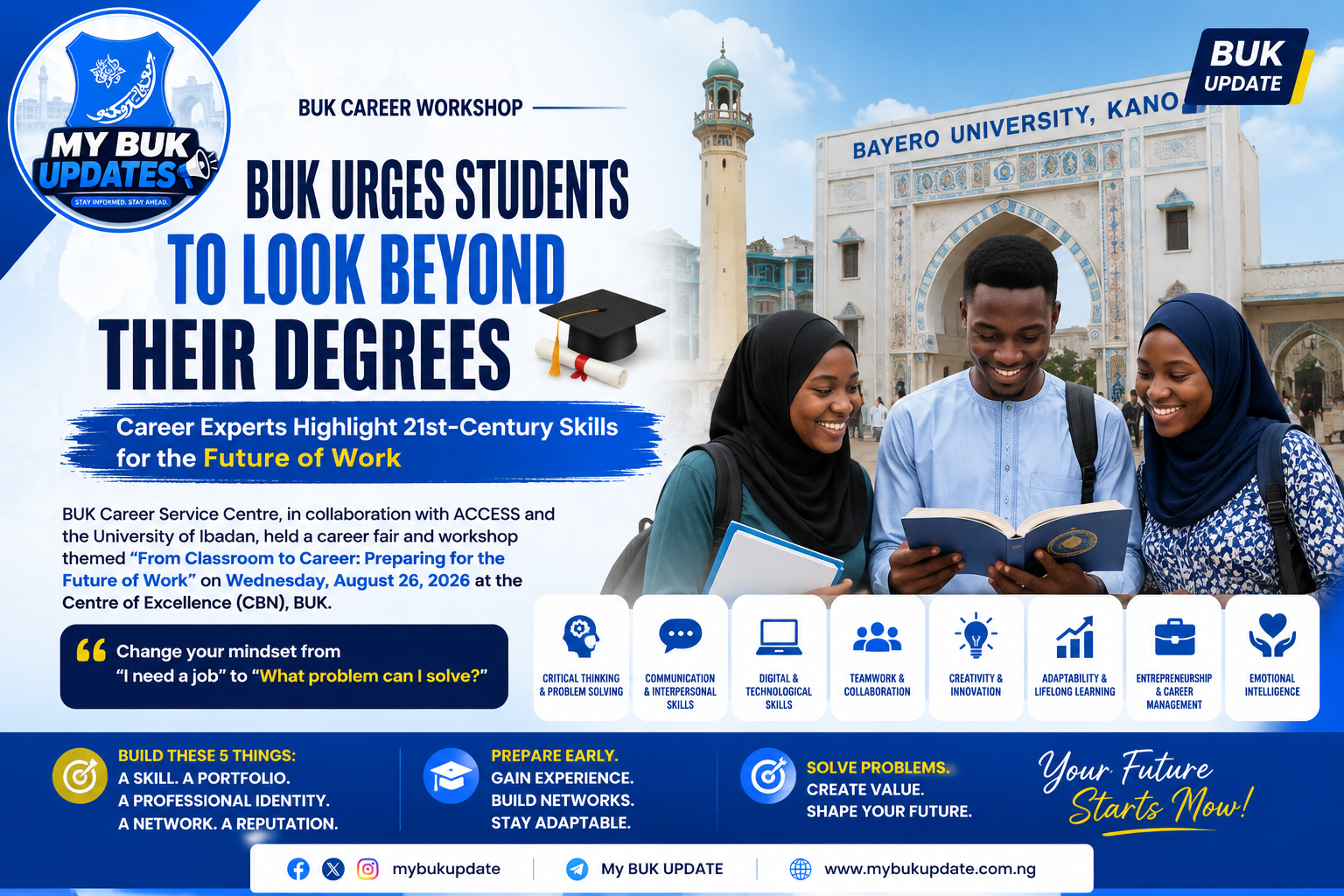
Bayero University, Kano (BUK) has advised students to look beyond their academic degrees and develop practical, professional and digital skills needed to succeed in the rapidly changing world of work.

The call was made during a career fair and workshop organised by the BUK Career Service Centre in collaboration with the African Centre for Career Enhancement and Social Skills (ACCESS) and the University of Ibadan.
The programme, themed “From Classroom to Career: Preparing for the Future of Work,” was held on Wednesday, August 26, 2026, at the Centre of Excellence (CBN), Bayero University, Kano.
The event brought together university management, career experts, employers, representatives of partner organisations, staff and students to discuss emerging employment trends, career pathways and strategies for improving graduate employability.
BUK: A University Degree Alone Is Not Enough
Declaring the workshop open on behalf of the Vice-Chancellor, Professor Haruna Musa, FSI, the Deputy Vice-Chancellor, Research and Development, Professor Amina Mustafa, described the programme as timely.
She noted that technological advancement, artificial intelligence, digital transformation and changing workplace expectations were rapidly reshaping the employment landscape.
Professor Mustafa stressed that possessing a university degree alone was no longer sufficient to guarantee career success. She encouraged students to complement their academic qualifications with skills including:
- Communication
- Critical thinking
- Problem-solving
- Teamwork
- Adaptability
- Digital competence
- Creativity
- Emotional intelligence
- Entrepreneurship
She also encouraged students to start preparing for their careers before graduation by developing technical and professional skills, participating in internships and practical experiences, building professional networks and seeking mentors.
Eight Skills Students Need for the Future
Delivering the keynote address titled “21st-Century Employability Skills: What They Are and How Best to Acquire Them,” Professor Adebola Babatunde Ekanola, mni, former Vice-Chancellor of the University of Ibadan and Nigerian Team Lead and board member of ACCESS, told students that the future of work was already unfolding.
According to him, employability involves more than academic knowledge. It combines technical competence, digital capabilities, soft skills, adaptability, entrepreneurial capability and ethical responsibility.
He identified eight major clusters of employability skills students should develop:
- Communication and interpersonal skills
- Critical thinking and problem-solving
- Digital and technological skills
- Creativity and innovation
- Teamwork and collaboration
- Personal effectiveness and emotional intelligence
- Career management and entrepreneurship
- Adaptability, lifelong learning and professional development
Professor Ekanola further encouraged students to use assignments, group projects, seminars, presentations, report writing and participation in organisations as opportunities to improve their communication and problem-solving abilities.
He also urged students to identify real-life problems within their various disciplines and develop projects capable of addressing them, noting that employers increasingly want graduates who can solve problems and create value rather than simply wait for instructions.
“What Problem Can You Solve?”
Speaking on “What Employers Want from University Graduates,” Wilson, a representative of the Nigeria Employers’ Consultative Association (NECA), challenged students to rethink what it means to be employable.
She stressed that a degree is only a starting point and that employers ultimately value what graduates can do with the knowledge they have acquired.
One of her key messages to students was to change their mindset from:
“I need a job”
to:
“What problem can I solve?”
She identified technical competence, digital competence, communication, integrity, professionalism, adaptability, resilience, learning agility and teamwork among the qualities employers seek.
Wilson also encouraged students to deliberately build five things: a skill, a portfolio, a professional identity, a network and a reputation.
She advised students to create evidence of their abilities through projects, internships and other practical experiences, while also using professional platforms to showcase their work.
Students were further cautioned to pay attention to their online reputation, as prospective employers may form impressions about candidates based on their digital footprints.
Career Paths Can Change
The workshop also featured a session on “Career Pathways and Emerging Job Opportunities in the 21st Century,” delivered by Oluwatayo Winkunle.
Using her personal career journey, Winkunle demonstrated how adaptability and reskilling can open new career opportunities.
She studied Biochemistry at the University of Agriculture, Abeokuta, but her career later moved through entrepreneurship, banking, data analytics, product management and technology.
After her National Youth Service Corps programme, she ventured into entrepreneurship before working as a banking salesperson. She later embarked on a reskilling journey through Business Analytics, which exposed her to broader opportunities in data and technology.
Her career subsequently evolved into product management and technology, including roles with Access Bank and Interswitch, before becoming Head of Product at a YCombinator-backed company.
Her experience reinforced the message that students should remain open to learning, adapting and repositioning themselves as new opportunities emerge.
The Message for BUK Students
The career workshop delivered a clear message: students should not wait until graduation before preparing for the world of work.
BUK students were encouraged to gain practical experience, develop relevant skills, build professional networks, seek mentorship and continuously improve their abilities.
The programme also provided students with opportunities to interact with career professionals, explore emerging career pathways and employment opportunities, develop employability competencies, build professional networks and gain practical insights into the changing world of work.
For today’s university student, academic success remains important—but the ability to communicate, adapt, solve problems, use technology, build relationships and create value can make a significant difference when entering the workforce.
As the workshop’s message emphasised, students should not only prepare themselves to get a job. They should also prepare themselves to create value and become problem-solvers, innovators and contributors to society.


Get involved!
Comments